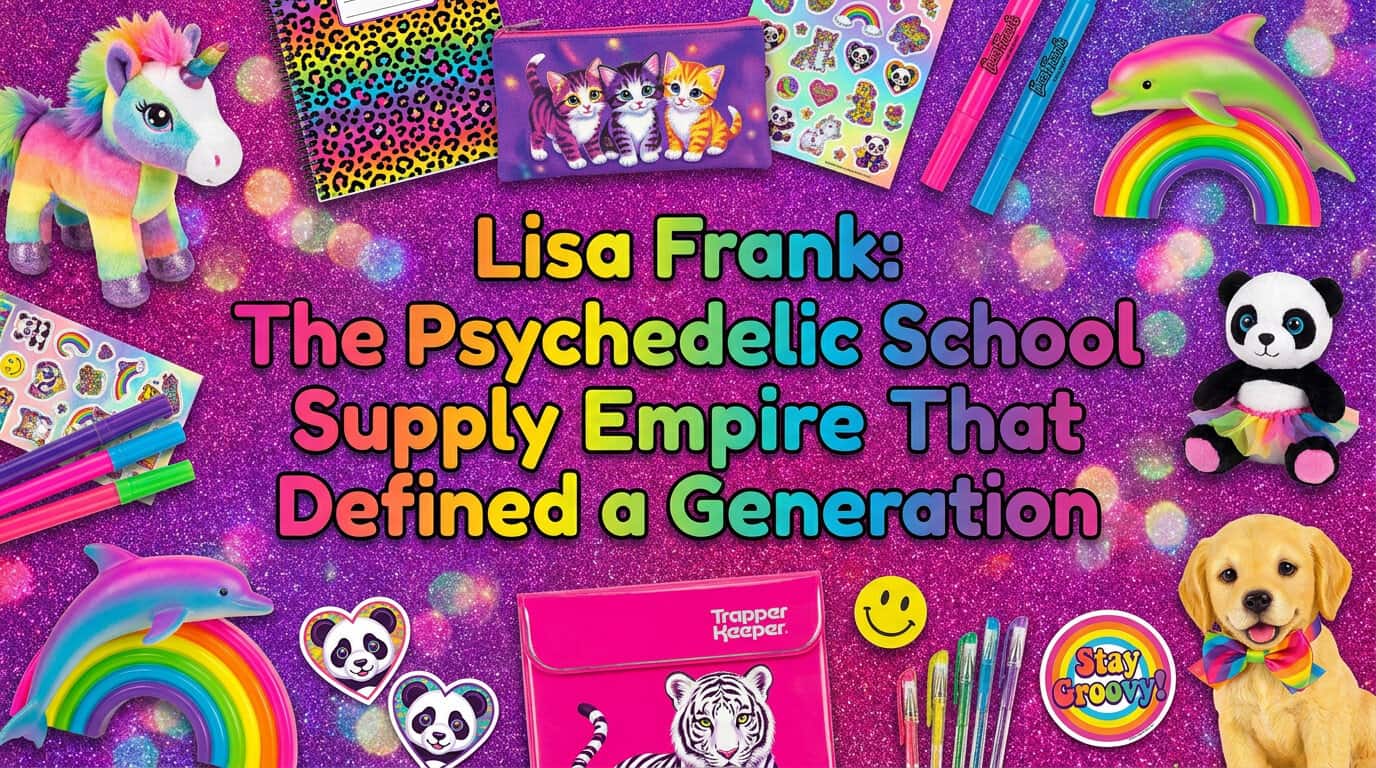
There was a moment every August, somewhere between the cereal aisle and the notebook section, when your whole body knew you were standing in front of something important. Row after row of folders, binders, and sticker sheets soaked in every color that ever existed. Dolphins leaping over neon rainbows. Unicorns with fur the color of cotton candy. Pandas wearing tiaras.
You were looking at Lisa Frank. And if you grew up in the late 80s or 90s, you understood instinctively that having the right Lisa Frank folder could make or break your entire school year.
No brand did more to turn school supplies into pure, uncut childhood joy. This is the full story from one woman’s obsessive vision to a $500 million empire to a shocking collapse to the nostalgia comeback nobody saw coming.
Before Lisa Frank: What School Supplies Looked Like in the 80s
Before the rainbow invasion, back-to-school shopping was… fine. Functional. Your folders came in solid colors red, blue, green, yellow maybe with a generic landscape printed on the front. Notebooks had marble covers. Pencil cases were clear plastic with a zipper.
Nothing about school supplies said “I have a personality.” They said “please store my homework safely.” Which, honestly, is a low bar.
Then Lisa Frank showed up and basically invented the concept of school supplies as self-expression. Suddenly what you carried said everything about who you were or who you desperately wanted to be.
The Rise of Lisa Frank Inc. From a College Dorm to a Technicolor Empire
Lisa Frank was a real person. That feels important to say because the brand is so maximalist, so almost-cartoonishly abundant, that “Lisa Frank” sounds more like a myth than a person’s name.
She was born in Detroit in 1955 and studied art at the University of Arizona in Tucson. By 1979, she’d launched her company out of a rented space with almost nothing, just her artwork, her vision, and a level of commitment to bright color that bordered on obsessive.
She designed everything herself in the early years. Every dolphin, every panda, every rainbow. The Tucson headquarters became legendary a compound painted head-to-toe in Lisa Frank colors, where employees wore company gear and the parking lot was reportedly painted in stripes. Even her wedding was Lisa Frank-themed. The woman lived her brand completely.
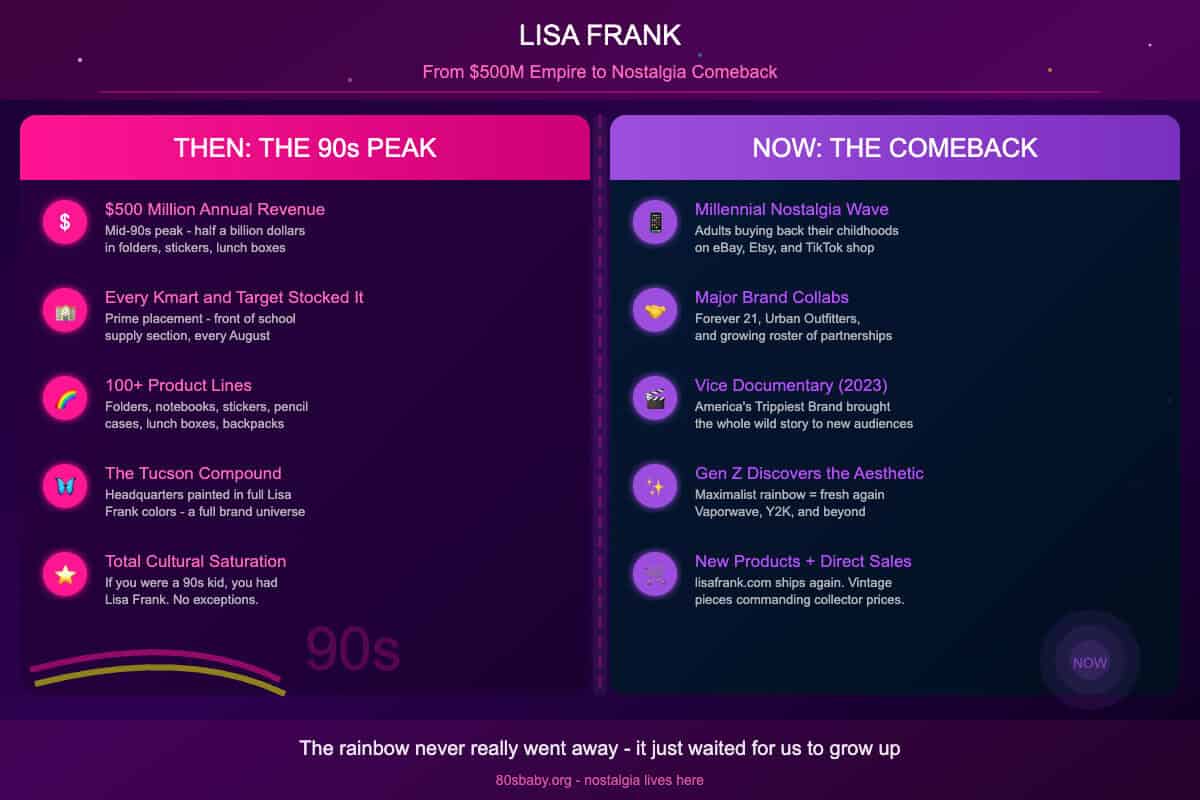
By the late 80s, the company was doing serious numbers. By the mid-90s, at peak Lisa Frank mania, revenue hit an estimated $500 million a year. Half a billion dollars in folders, stickers, and lunch boxes. Wrap your head around that.
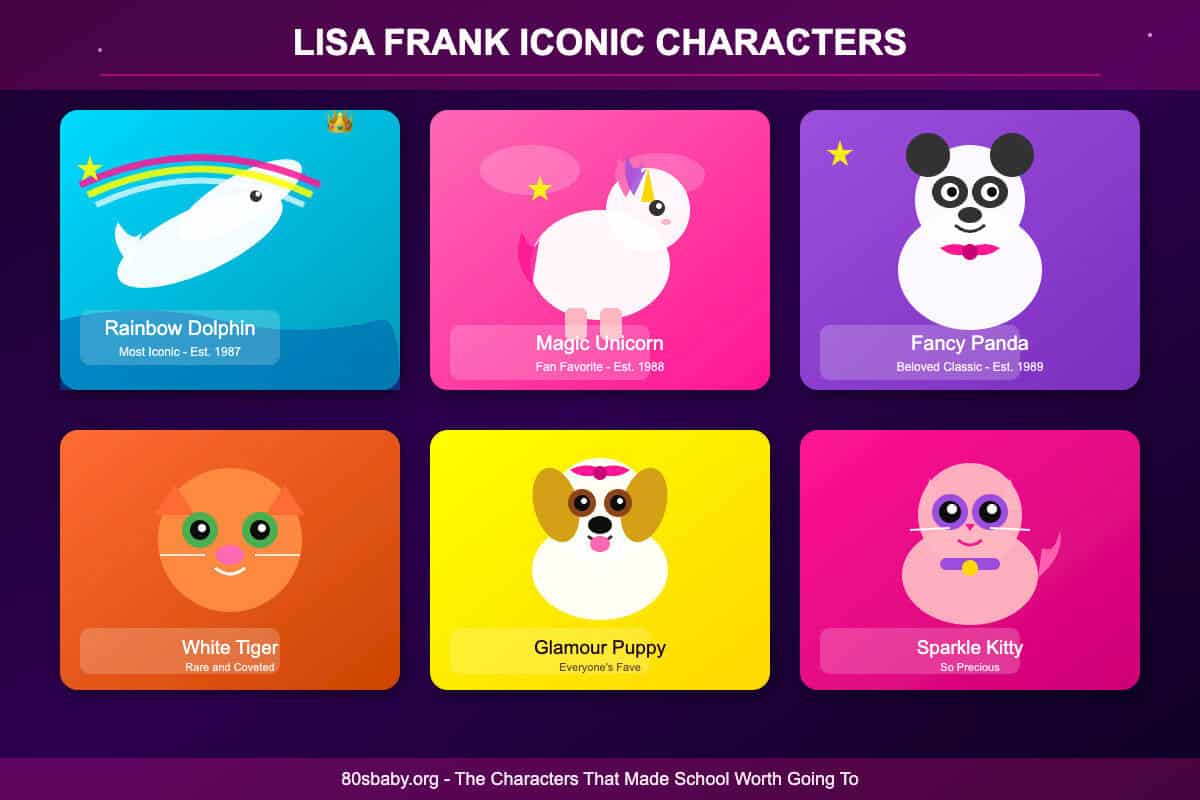
The Iconic Characters: Dolphins, Unicorns, Pandas, and the Art That Launched a Thousand Trapper Keepers
You could always recognize a Lisa Frank product from across a Kmart at thirty yards. The palette was unmistakable hot pink, electric blue, neon purple, blinding yellow, and approximately seventeen shades of teal, all somehow coexisting in harmony.
The characters were creatures reimagined as fantasy versions of themselves. Dolphins didn’t just swim they leapt through cosmic neon skies over rainbows. Horses weren’t horses, they were unicorns with flowing manes in five colors at once. Puppies weren’t just puppies; they were doe-eyed, impossibly cute, posed in hearts and flowers with expressions that said “I will love you unconditionally and also I glow in the dark.”
The pandas were maybe the most iconic. Black-and-white pandas wearing bright accessories, bows, tutus, and and roller skates against pastel backgrounds. Every kid had an opinion on which Lisa Frank character was superior. (The correct answer is the rainbow dolphin. We can argue about this.)
If you had a Trapper Keeper with a Lisa Frank cover, you were operating at a different altitude than your peers. That was status. That was power. That was knowing you made the right call at the school supply aisle.
Why Every 90s Kid Had to Have Lisa Frank on the First Day of School
There was a specific social economy operating in elementary school hallways, and Lisa Frank was the currency.
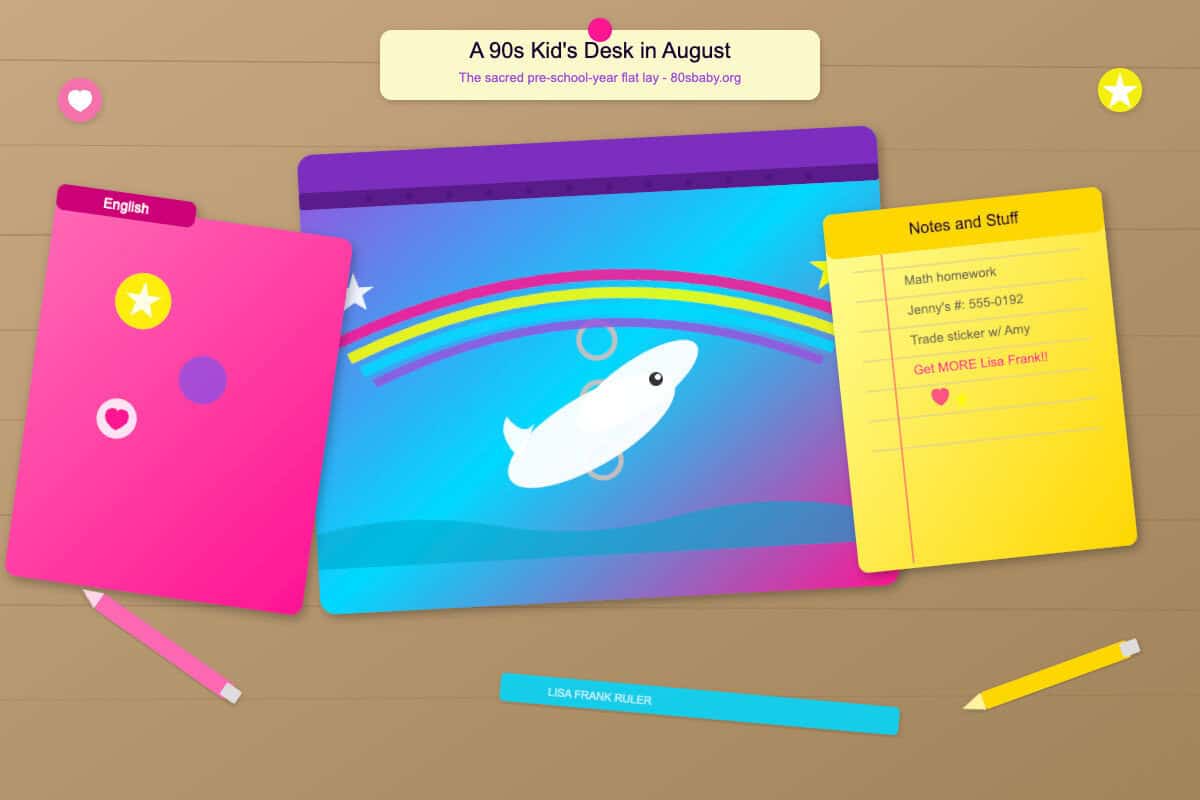
Who had the holographic sticker sheet? Who had the pencil case with the sparkle panels? Who had the folder with the white tiger? These weren’t casual observations. They were assessments. You filed this information away, and it shaped the entire social landscape of your grade for months.
The stickers especially were a kind of economy. You traded them. You collected them. You had a specific book or binder dedicated to their preservation. Putting a Lisa Frank sticker directly on something permanent was a commitment you didn’t make lightly.
The Back-to-School Shopping Ritual: A Core Memory for 80s Babies
If you grew up in the late 80s and 90s, you know the specific feeling of the back-to-school shopping trip. It was an event. Not just an errand.
Your mom handed you the supplies list from school a photocopied sheet specifying how many folders, what size notebooks, what kind of crayons. What the list did NOT specify was which Lisa Frank design you chose. That was the one moment of complete creative freedom in the whole transaction.
You took it seriously. You stood at the display for longer than any reasonable person should stand anywhere. You considered all your options. You maybe agonized a little. Because you were going to carry this folder for a whole school year and it had to be right.
Those trips also hit different at places like Kmart, Walmart, and Target all competing to have the biggest Lisa Frank section. Some schools had the Lisa Frank display right inside the entrance. A smart placement. A power move.
Inside the Tucson Factory: The Mysterious World Behind the Rainbow
The Lisa Frank headquarters in Tucson, Arizona was the stuff of legend even before the internet gave everyone access to inside information. In the 90s, it was simply known: there was a place in the desert where all these beautiful things were made, and it was probably magical.
The reality was a sprawling, colorfully painted campus where hundreds of employees worked in a company culture that was, by many accounts, intensely immersive. Lisa Frank herself had total creative control. The work was proprietary. The compound was not toured. It had the mystique of Willy Wonka’s factory you knew incredible things came out of it, but you couldn’t see inside.
This mystery was part of the brand’s magic. Lisa Frank existed in a world separate from the ordinary. You didn’t need to know how the sausage was made. You just needed the rainbow dolphin folder.
The Dramatic Downfall: What Happened to Lisa Frank Inc.
In 2013, a court filing cracked the compound open, and what came out was a story that felt nothing like the brand it described.
Lisa Frank and her then-husband James Green (who ran the business side) went through a highly public, intensely bitter divorce. Court documents alleged a deteriorating work environment, mismanagement, and a company culture that had become deeply toxic. Former employees described chaotic conditions inside the once-celebrated headquarters.
The company had already been declining from its mid-90s peak. Tastes changed. The 2000s weren’t kind to maximalist neon. The brand had been coasting on nostalgia and licensing without the explosive cultural moment it once owned.
By the mid-2010s, Lisa Frank Inc. was a shadow of its former self. The physical empire had shrunk dramatically. The Tucson headquarters, once painted in full Lisa Frank glory, grew quieter. It was a fall from grace so dramatic that it almost felt impossible how do you go from $500 million to this?
Lisa Frank’s Cultural Comeback: Collabs, Docs, and Adult Nostalgia
Then something happened that nobody fully predicted: millennials grew up, got disposable income, and started buying back their childhoods.
The Lisa Frank nostalgia wave hit hard in the 2010s and just kept building. Adults who had the folders as kids started hunting for vintage pieces at thrift stores and on eBay. The brand started collaborating with Forever 21, Urban Outfitters, and a string of fashion and lifestyle brands who understood that Lisa Frank wasn’t just nostalgia it was an aesthetic identity.
The 2023 documentary “Lisa Frank: America’s Trippiest Brand” on Vice brought the whole story to a new audience. Suddenly everyone was talking about the Tucson compound again, the divorce, the decline, and also the undeniable genius of what Lisa Frank had created. Her imagery is genuinely singular. There is nothing else that looks quite like a Lisa Frank product, before or since.
The brand also launched online direct sales, new sticker books, and collaborations that brought the product to Gen Z kids who had no personal memory of the original era but responded to the maximalist rainbow aesthetic s if it was entirely fresh. Because it kind of was.
The Lisa Frank Aesthetic and Its Influence on Vaporwave, Y2K, and Modern Design
Here’s the thing about Lisa Frank that gets overlooked: the aesthetic was genuinely ahead of its time.
Neon color palettes over dark backgrounds. Maximalist layering of visual elements. Animal characters elevated to fantasy status. A complete rejection of muted, “tasteful” design in favor of MORE. And more. And then more on top of that.
Sound familiar? That’s vaporwave. That’s the Y2K revival. That’s the visual language of TikTok’s most shareable aesthetics. Lisa Frank was doing in 1990 what internet culture has been doing since 2015.
The influence also shows up in contemporary fashion, streetwear, and even graphic design circles where “maximalism” has become a legitimate and respected direction. The aesthetic that was dismissed as “too much” in the early 2000s is now exactly the point.
Where to Find Lisa Frank Today: Collecting, New Products, and Keeping the Magic Alive
Lisa Frank products are still being made and sold through the official website at lisafrank.com. New sticker books, accessories, and collaborations continue to drop. The brand has found its footing in the adult collector market while also reaching new young fans.
For the serious vintage collector, eBay and Etsy are gold mines. Sealed original 90s sticker sheets can fetch significant prices. Vintage Trapper Keepers with Lisa Frank designs in good condition are legitimately collectible. The rarer the character or design, the higher the price some serious collectors are paying hundreds for the right pieces.
Thrift stores in areas with heavy 90s families (which is basically everywhere now) sometimes yield actual vintage finds. The hunt is part of the joy. You’re not just buying a folder you’re recovering a piece of your own history.
The nostalgia toy and collectibles market has been exploding for years, and Lisa Frank rides that wave beautifully. If you have original pieces in good condition, they may be worth more than you think.
Why Lisa Frank Hits Different for 80s Babies
Here’s what it comes down to: Lisa Frank understood something that most brands don’t that kids want to feel like they live inside a fantasy, not just adjacent to one.
Every Lisa Frank product was a portal. You weren’t just carrying a folder. You were carrying a whole world where dolphins flew and pandas wore tutus and everything was the most saturated version of itself possible. You were allowed to want that world, to believe in it, to carry it to school every day and open it in front of everyone.
For 80s babies who grew up with those products, there’s a specific ache when you see a Lisa Frank design now. It’s the feeling of being seven years old in August, standing in the school supply aisle, about to make the most important decision of your young life.
The rainbow dolphin. The white tiger. The panda in the bow. You still remember which one you chose. And honestly? You chose correctly.
Frequently Asked Questions About Lisa Frank
Is Lisa Frank a real person?
Yes. Lisa Frank was born in Detroit in 1955 and founded Lisa Frank Inc. in Tucson, Arizona in 1979. She designed the artwork herself in the early years and maintained creative control throughout the company’s peak era. The brand is named after its real founder.
What happened to Lisa Frank Inc.?
After reaching an estimated $500 million in annual revenue in the mid-90s, the company declined significantly through the 2000s and was rocked by a high-profile, acrimonious divorce between Lisa Frank and her then-husband and business partner James Green in 2013. Court documents revealed serious internal problems. The company shrank dramatically but survived and continues to operate today.
Can you still buy Lisa Frank products?
Yes. Lisa Frank products are available at lisafrank.com, through various retail partnerships, and through collaborations with other brands. For vintage original products from the 80s and 90s, eBay and Etsy are the best sources.
Are original Lisa Frank products valuable?
Original sealed or unused Lisa Frank products from the late 80s and 90s can be collectible, particularly rare designs or items in excellent condition. Vintage Trapper Keepers and sealed sticker sheets command premium prices from collectors. Values vary widely based on rarity, condition, and the specific design.
What was the most popular Lisa Frank design?
The rainbow dolphins and unicorns were consistently among the most beloved designs. The iconic rainbow dolphin jumping over a neon sunset became one of the most recognizable images in the brand’s history and remains a touchstone for 90s nostalgia culture.
The Bottom Line
Lisa Frank didn’t just sell school supplies. She sold the radical idea that the everyday objects kids carried around could be extraordinary that a folder didn’t have to be a folder, it could be a statement, a joy, a whole aesthetic universe in your backpack.
For those of us who grew up choosing our Lisa Frank designs with dead seriousness every August, that idea left a mark. We’re the generation that now applies that same energy to everything our phone cases, our sneakers, our home decor. We learned young that there’s a better option than beige.
Thanks, Lisa. We owe you one.
What was your favorite Lisa Frank design? Drop it in the comments and check out our deep dive on the Trapper Keeper and the essential back-to-school supplies of the 90s while you’re here.