
Ever wondered who made the first smartphone? While many people think Apple created the first one with the iPhone, the real story is much older and more interesting. Let me tell you about a special phone called the IBM Simon that changed everything.
When Phones Were Just for Calling
Back in the 1980s and early 1990s, phones were very different from what we have today. They were big, heavy, and could only make calls. Imagine carrying around a brick-sized phone that couldn’t do anything else, no games, no internet, not even text messages!
The first mobile phone was called the Motorola DynaTAC 8000X. It weighed as much as two hamburgers and could only make phone calls. That was normal back then. Nobody expected phones to do more than that.
The First True Smartphone: The IBM Simon

Then, in 1994, a company called IBM created something new and exciting, the IBM Simon Personal Communicator. This wasn’t just a regular phone. It was the first phone that could do many of the things our modern smartphones do today.
It was a true pioneer, and the leap in technology was stunning.
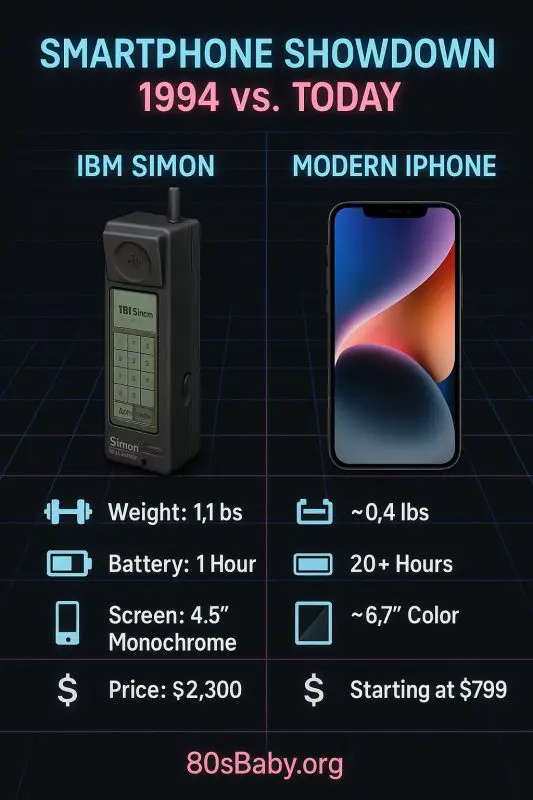
At a Glance: Simon vs. Today
To understand how revolutionary the Simon was, just look at how it compares to a modern smartphone.
A Pocket Computer in 1994
Think about using the Simon Phone. The screen was black and green (like an old computer), and it was as thick as a sandwich. But it could do amazing things that no other phone could do at the time.
For the first time, one device could:
Make and receive phone calls
Send and receive emails (when most people didn’t even use email)
Send and receive faxes (like emailing paper)
Function as a digital calendar to schedule appointments
Keep a list of phone numbers in an address book
Let you write notes on a digital notepad
Run third-party applications (with a special memory card)

The Simon wasn’t perfect. Its battery only lasted about an hour, shorter than most TV shows! It was also incredibly expensive. Even with these problems, about 50,000 people bought one. They knew they were using something special that would change how we use phones forever.
Why Nobody Remembers the Simon
Here’s something funny , when IBM made the Simon, nobody called it a “smartphone” because that word hadn’t been invented yet! It was so new that people didn’t know what to call it. It was like having a car before anyone came up with the word “automobile.” Because it was so ahead of its time, it faded from memory before the world was truly ready for it.
While the Simon faded, the idea it sparked did not. A few years later, devices like the Nokia 9000 Communicator (1996) and the first BlackBerry (1999) would pick up where the Simon left off, slowly paving the way for the smartphone revolution we know today.
The Simon’s Legacy Today
The Simon phone taught us an important lesson, sometimes the first version of something isn’t perfect, but it’s still very important. Think about riding a bike with training wheels; it’s not as good as riding without them, but it’s how we learn.
The Simon might seem old and simple now, but it was the beginning of something big. It showed everyone that phones could be more than just phones – they could be tiny computers we carry everywhere. Every time you tap your phone’s screen, check your calendar, or download a new app, you’re using ideas that started with the IBM Simon. It was the grandfather of all smartphones, and without it, our phones today might be very different.
Want to Know More?
What do you think phones will be able to do in the future? Maybe they’ll be able to show holograms or fold up like paper! The Simon Phone showed us that anything is possible with new ideas and hard work.