Lotería in the Classroom: A Bilingual Christmas Game for Spanish Class
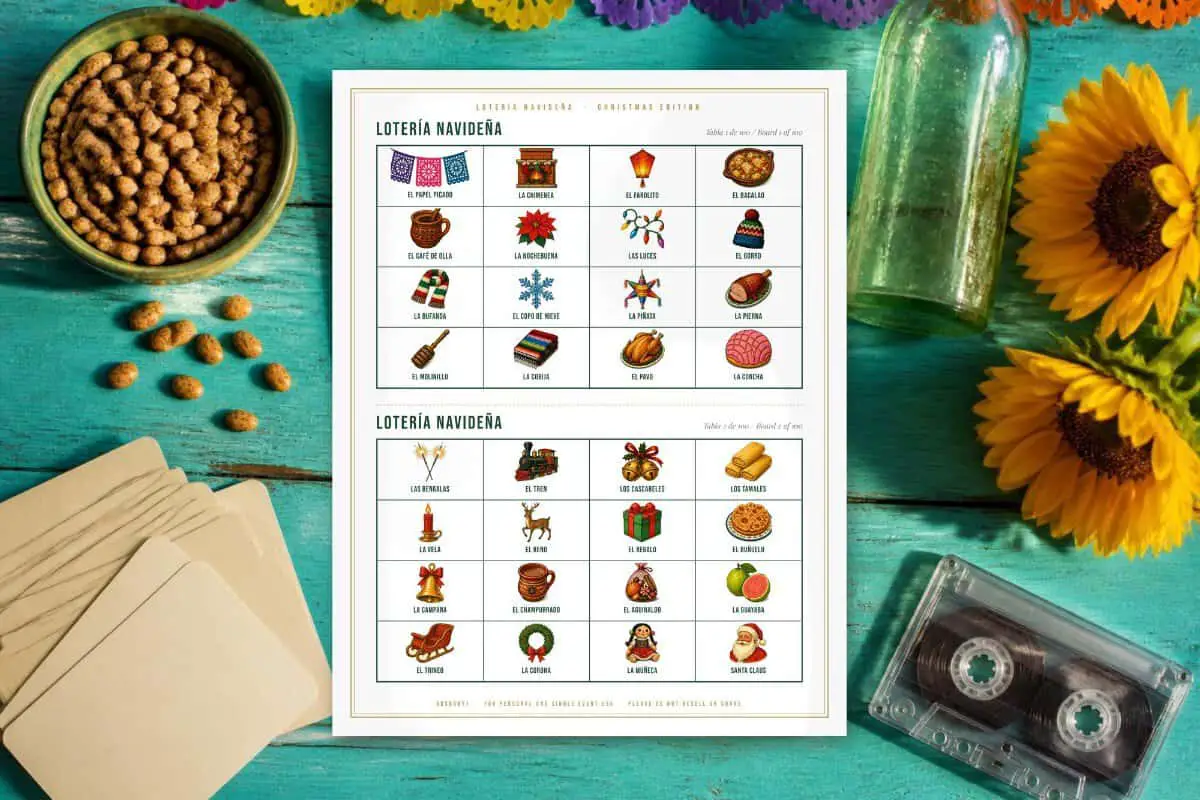
The last week before winter break, nobody wants a worksheet. Lotería gives your class a game that feels like a party and still has every student hearing, reading and saying Spanish words for the whole period.
If you have never played it, Lotería is the Mexican picture card game families pull out at Christmas. One person calls a card, everyone looks for that picture on their board, and the first one to fill the pattern yells ¡Lotería! It looks like bingo. The pictures and the calling are what turn it into a language lesson your students won’t notice they’re taking.
Why Lotería works in Spanish class
Most review games reward the fastest kid in the room. Lotería rewards the one who listened. Here is what it practices without you having to say so:
- Listening. Students have to understand the word before they can mark it. Nobody can coast.
- Reading. Every card has the word printed under the picture, so they connect the sound to the spelling.
- Speaking. When someone wins, they read their marked words back out loud. Then they call the next round.
- Every level at one table. A newcomer, a heritage speaker and a kid in Spanish 1 can play the same game, because the picture does the heavy lifting.
- Real culture. This is a game real families play in December, not something made up for school.
It looks like bingo. It plays like a listening quiz nobody minds taking.
What you need
- Tablas. One printed board per student, or one per pair.
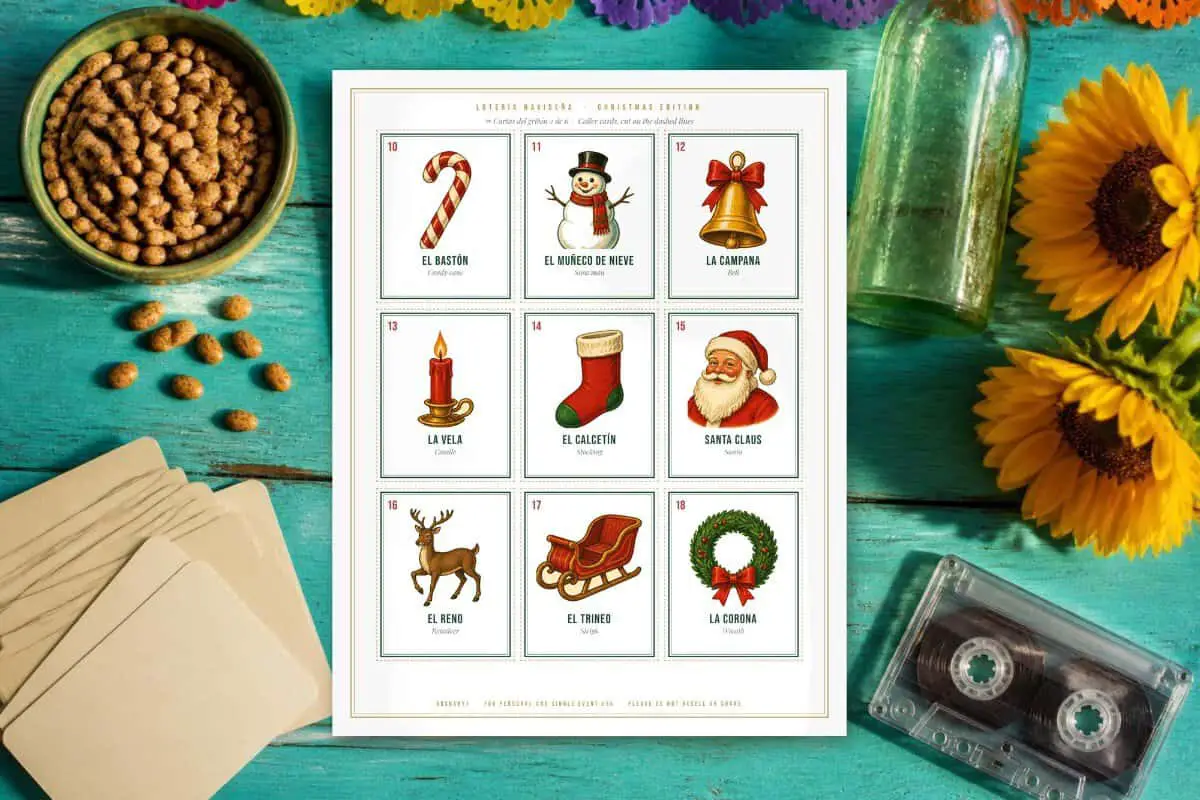
- The deck. The 54 cards for the caller, cut apart. Card stock holds up better if you play every year.
- Markers. Dried beans are the classic. Pennies, mini erasers or little squares of scrap paper work too, and paper sweeps up easier.
- A way to show the card. Hold it up, or put it under the document camera.
- A small prize. First pick from the candy bowl, line leader, or the big one: calling the next round.
Printing tip: Regular paper is fine for one game. For a set you can use every December, print the tablas on card stock and slip each one into a sheet protector. Students mark with dry erase markers, you wipe them clean, and next year the prep is already done.
How to run a Lotería round
01
Teach the words first
Spend five minutes on the vocabulary before you play. Show each picture, say the word, have the class say it back. The vocabulary sheet makes this part easy.
02
Agree on the win
Start with one line in any direction. Save four corners and the full board for the second and third rounds. Our full Lotería guide has a diagram of every pattern.
03
Call in Spanish, then English
Read the Spanish clue, pause for a few seconds, then read the English line. Beginners get their safety net. Stronger students try to mark it before the English comes.
04
Check the winner out loud
When someone yells ¡Lotería!, they read their marked words back in Spanish. If a word is wrong, the game keeps going.
05
Hand over the deck
The winner becomes the caller, el gritón, for the next round. This is where the real speaking practice happens, and the kids love being in charge.
Make it easier or harder
Same deck, same tablas. You just change how you call it.
| Class | How to call | How to win |
|---|---|---|
| Beginners and Spanish 1 | Spanish word, then English, then show the picture | One line |
| Middle levels | Spanish clue only, show the picture after a pause | Four corners |
| Advanced and heritage speakers | Spanish clue only, no picture, students take turns calling | Full board, then a sentence with each marked word |
For a mixed class, let advanced students call while beginners play. Everyone stays busy at their own level.
The Christmas words students will pick up
A few of the cards in our deck, so you can see the kind of vocabulary you are teaching:
- la piñata (the piñata)
- el ponche (warm fruit punch)
- los tamales (tamales)
- el árbol (the tree)
- las luces (the lights)
- el farolito (the little lantern)
- la nochebuena (the poinsettia)
- el pavo (the turkey)
- el gorro (the winter hat)
Tip: Before class, pull ten cards and put them on the board. Students who know those ten can follow the whole game, and they will pick up the rest while they play.
A one period plan
For a 45 or 50 minute class:
- 5 minutes: vocabulary warm up with the pictures.
- 5 minutes: rules and the winning pattern for round one.
- About 30 minutes: three rounds. One line, four corners, full board.
- 5 minutes: wrap up. Each student writes three new words and one sentence on an exit ticket.
Short on time? One round to a single line still works as a warm up or a reward at the end of a test day.
Lotería FAQ for teachers
What grade is Lotería good for?
Any grade that can match a picture to a word. Younger kids play with the picture and the English line as a safety net. High school classes play with the Spanish clue only.
How many students can play?
As many as you have tablas. With 30 tablas, most classes give every student their own board. Bigger classes can play in pairs, which also gets them talking.
How long does a round take?
A round to one line usually takes around ten minutes. Four corners and the full board take longer, so plan two or three rounds in a class period.
Is Lotería the same as La Lotería de Navidad?
No. La Lotería de Navidad is the big Christmas lottery draw in Spain. Lotería the picture card game comes from Mexico. Both make good culture lessons, they are just different ones.
Can I play it on a projector?
Yes. Put the called card on the screen so the whole room sees the picture while you say the word. It helps students in the back and anyone still learning to read the words.
Ready for your last week before break
Print the tablas, grab a bag of beans, and let your students run the room for a day. If you want the rules in English and Spanish to share with your class, our how to play Lotería guide has everything, including the winning patterns.
Skate the neon mall, grab the 80s, dodge the 90s. Race your friends with one link. Works on your phone.
Play the game Shop 80s party games