80s Slang Words and Phrases We Actually Said Back Then
The year is 1984. You walk into school and your best friend grabs your arm, eyes wide. “Dude. Did you hear? She dumped him. Right there in the hallway. It was totally grody.” You nod, because you know exactly what she means without anyone explaining a single word.
That’s what made 80s slang so good. It was a whole vocabulary that made perfect sense to exactly the right people and absolute zero sense to anyone’s parents. We didn’t realize we were documenting a cultural moment. We were just trying to describe our lives.
What Is 80s Slang?
80s slang was a collection of words and expressions that teenagers and young adults used throughout the decade to signal approval, disgust, excitement, and tribal belonging. Terms like “radical,” “gnarly,” “tubular,” “gag me with a spoon,” and “bogus” defined how a generation communicated, shaped by surfer culture, Valley Girl speak, hip hop, and the movies we watched every weekend at the multiplex.
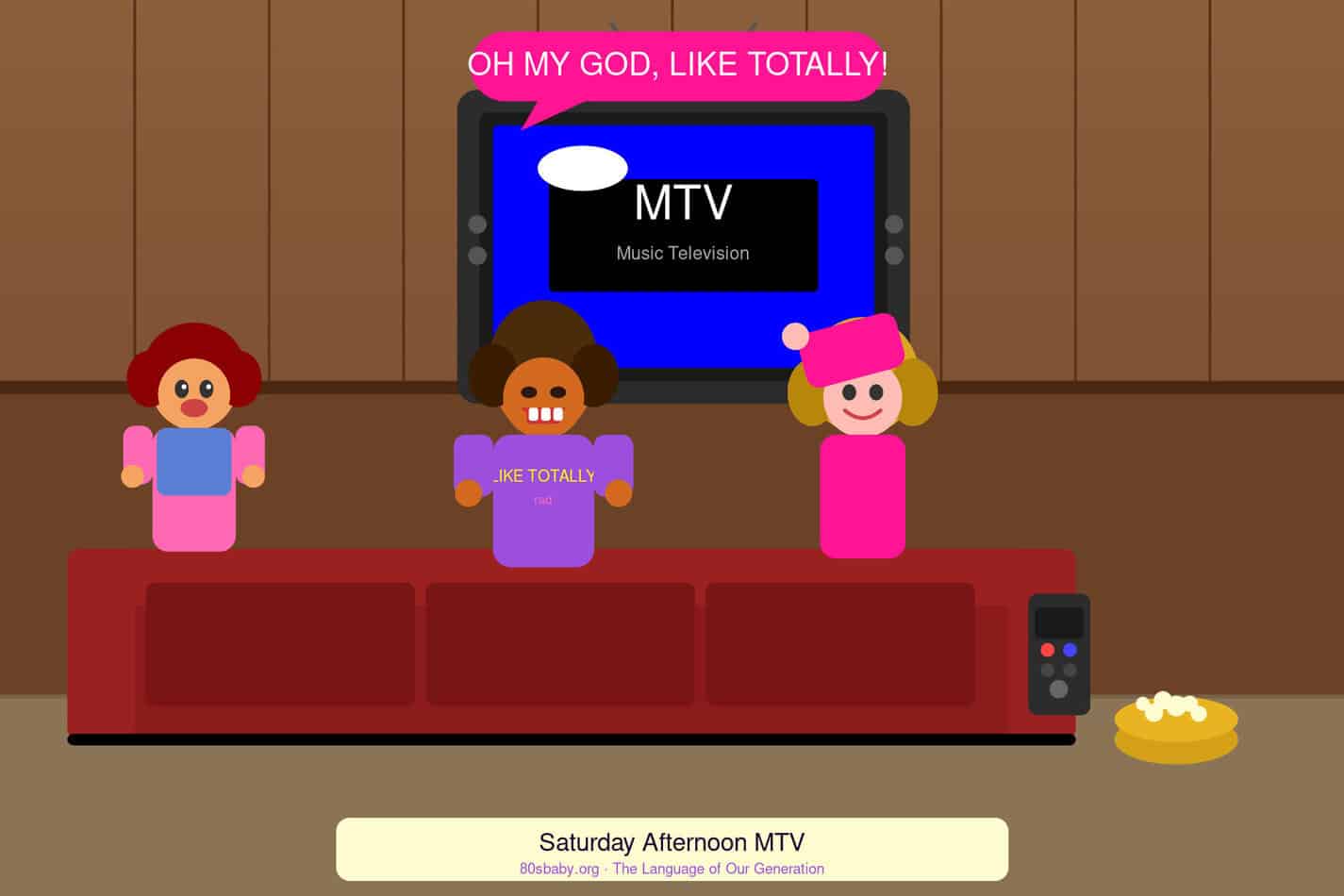
The decade had several overlapping dialects running at once: Valley Girl speak from the San Fernando Valley, surfer and skater slang from the coasts, hip hop language from New York and Los Angeles, and a general teen vocabulary that spread through MTV like wildfire. What’s remarkable is how many of these words are still instantly understood four decades later.
The Valley Girl Dictionary
Nobody defined 80s slang quite like the Valley Girl, and nobody put it on the map quite like Frank Zappa. His 1982 song “Valley Girl,” featuring his sixteen-year-old daughter Moon Unit, catalogued the entire dialect in three and a half minutes. After that, every mall from Encino to New Jersey was using the same words.
“Gag me with a spoon” was the ultimate expression of disgust. Not mild annoyance, but full dramatic horror performed for maximum effect. If your mom served tuna casserole again or your crush showed up with someone else, that was gag-me-with-a-spoon territory.
“Totally” became an all-purpose intensifier that attached to everything. Totally awesome. Totally weird. Totally whatever. It turned regular adjectives into statements. Something wasn’t just “fine” — it was “totally fine,” and you heard the difference in someone’s voice.
“For sure,” sometimes spelled phonetically as “fer sure,” was Valley Girl agreement. You said it when you meant yes, when you meant obviously, and sometimes just to fill space between thoughts. “Like” served a similar function, appearing in grammatically inexplicable positions and somehow making perfect conversational sense anyway.
The Surfer and Skater Words
Surf culture gave the decade some of its most durable vocabulary. “Gnarly” started as a surfing term for a wave that was dangerously good, the kind that could either give you the best ride of your life or break your board in half. By the early 80s it had traveled far inland to mean anything extreme, impressive, or disturbing depending on context. A gnarly crash. A gnarly test. A gnarly piece of pizza that had been in your bag since Tuesday.
“Rad,” short for radical, was pure surfer-to-mainstream approval. Something rad was exceptional in a way that made you want to use it as a complete sentence. “That is rad.” Period. No elaboration needed. It carried a finality that longer words couldn’t match.
“Tubular” referenced the hollow inside of a perfectly formed wave, the tube surfers tried to thread through at full speed. Off the beach it came to mean something excellent, though it always had a slightly performative quality. Saying something was tubular was its own kind of statement.
“Stoked” meant genuinely, physically excited, the way your whole body felt before something you’d been anticipating for weeks. You weren’t stoked about your science project. You were stoked about the concert, the road trip, the summer.
“Shred” meant to perform brilliantly at something, borrowed from the skating and surfing idea of shredding a surface. A guitarist could shred. A skater could shred. You could shred a test if you’d actually studied for once.
The General Teen Vocabulary
Beyond California, the wider teen population absorbed and invented their own vocabulary through MTV, John Hughes movies, and the general cultural osmosis of the decade.
“Awesome” is the one that stayed. We’ve been saying it for forty years and it shows no signs of leaving. In the 80s it still felt potent. Not everything was awesome, just the things that deserved the word.
“Bogus” meant unfair, fake, or genuinely disappointing. A bogus situation was one where the universe had clearly done you wrong. Bill and Ted’s Excellent Adventure gave it a second life in 1989, but bogus was already well established in daily vocabulary long before Keanu Reeves got involved.
“Righteous” arrived from religious language and came to mean genuinely good, impressively cool in a way that felt earned. A righteous cause. A righteous dude. Someone who was actually righteous deserved the compliment in a way that “cool” couldn’t convey.
“Dude” started as West Coast surfer vocabulary and became universal by approximately 1983. It functioned as greeting, expression of disbelief, urgent call for attention, and general acknowledgment of another person’s existence. “Dude” said with enough different inflections could communicate an entire paragraph.
“No duh” was the 80s version of “obviously,” delivered with just enough exasperation to make the other person feel mildly ridiculous for saying something so self-evident.
Words for Good Things
The decade gave us a remarkable variety of ways to say something was excellent, and they were not interchangeable. The word you chose revealed which tribe you belonged to.
“Bad” meaning good is older than the 80s, but Michael Jackson’s 1987 album cemented it in mainstream consciousness. “That is so bad” said with the right tone meant something was spectacular. It confused parents reliably and persistently, which was part of the appeal.
“Fresh” came from hip hop, specifically from the New York scene, and meant new, innovative, or stylish in a way that felt intentional rather than accidental. You were fresh if your outfit was working. A fresh beat was one you hadn’t heard before but immediately recognized as something.
“Fly” worked in a similar register: fashionable, stylish, impressive in a way that looked effortless even when it wasn’t. To be fly was a specific kind of cool that carried its own confidence.
“Def” was hip hop shorthand for definitely good, undeniably excellent. A def jam. A def beat. Something you couldn’t argue with even if you wanted to.

Words for Bad Things
Equal creative energy went into the vocabulary for terrible.
“Grody” and “grody to the max” meant disgusting or thoroughly revolting. The “to the max” intensifier was available for most negative terms in the 80s. Things weren’t just bad, they were bad to the max, which meant they had achieved the outer limit of badness available.
“Lame” meant boring, uncool, or ineffective. A lame party. A lame excuse. A lame teacher who actually collected homework on Friday afternoons. Lame was judgment without heat, more disappointed than angry.
“Rip-off” described anything that cost too much or delivered too little. In the 80s this applied to arcade games that ate your quarters in thirty seconds, concert T-shirts that disintegrated in the wash, and mall food court items that looked better in the display photo than in reality.
The Catchphrases
The 80s also gave us lines from movies, commercials, and TV that escaped into daily conversation and never went back.
“I’ll be back” came from The Terminator in 1984 and immediately became the most quoted movie line of the decade. It worked as a threat, a promise, and a mild comedy reference depending on exactly how you said it.
“Where’s the beef?” started as a Wendy’s commercial in January 1984 and within months had become a general-purpose question about substance and follow-through. Walter Mondale used it against Gary Hart in a primary debate that year, which tells you how fast it traveled.
“Just do it” arrived from Nike in 1988 and immediately expanded beyond sports to apply to every situation involving hesitation and a decision that needed to be made.
“Who ya gonna call?” needed no explanation by late 1984. Ghostbusters had been out for six months and every kid in America already knew the answer.
How Well Do You Know Your 80s Slang?
10 questions. No studying. Pure decade instinct.
FAQ About 80s Slang
What were the most popular 80s slang words?
The most widely used 80s slang words were “awesome,” “radical” (or “rad”), “totally,” “gnarly,” and “dude.” These terms crossed regional and social boundaries to become part of mainstream teen vocabulary across the entire decade. “Awesome” is the only one that has remained in everyday use without nostalgia quotation marks around it.
What did “grody” mean in the 80s?
“Grody” meant disgusting or revolting, and it originated in Valley Girl slang in Southern California. The phrase “grody to the max” indicated something had reached the absolute outer limit of disgusting. It was popularized by Frank Zappa’s 1982 song “Valley Girl” and spread nationally from there.
Where did 80s slang come from?
80s slang drew from several sources at once. Valley Girl culture in Southern California gave us “gag me with a spoon,” “totally,” and “for sure.” Surf and skate culture contributed “gnarly,” “rad,” and “stoked.” Hip hop from New York and Los Angeles brought “fresh,” “fly,” and “def.” MTV connected these regional dialects into something that felt national by 1983.
Is any 80s slang still used today?
More than you’d think. “Awesome” never left. “Dude” is everywhere. “Stoked,” “gnarly,” and “rad” are still used by surfers and skaters with zero irony attached. “Bogus” and “righteous” surface periodically through movies, shows, and the nostalgia cycle that keeps pulling the 80s back into the present.
What did “totally tubular” mean?
“Totally tubular” meant something was excellent or extremely cool. “Tubular” referenced the hollow tube inside a perfectly shaped wave, so it carried a sense of something perfectly formed and exhilarating. Adding “totally” as an intensifier was characteristic of both Valley Girl speech and general 80s enthusiastic expression.
If you grew up in this decade, you know how these words felt in your mouth. The way “gnarly” took just the right amount of time to say. The way “no duh” landed with exactly the right weight. We set these words down somewhere in the early 90s without much ceremony. But they never really left. They just waited.
Hear them now and you’re right back. The hallway. The mall. The moment before everything happened.
For more 80s nostalgia, check out our complete guide to 80s nostalgia, the 80s karaoke songs that belong on every throwback playlist, and our roundup of 80s party games for your next throwback night.