Why Millennials Are the Most Nostalgic Generation Right Now
We are the only generation that can tell you exactly what the internet sounded like.
Think about that for a second. Nobody before us heard it, because it was not there yet. Nobody after us heard it, because by then it was silent and already in their pocket. We heard it every single day, screeching and beeping through the wall while somebody yelled from the kitchen that they needed the phone.
That is the whole reason millennials are the most nostalgic generation right now. Let me explain.
If this post has you missing game night with no screens in the way, this is how I bring it back.
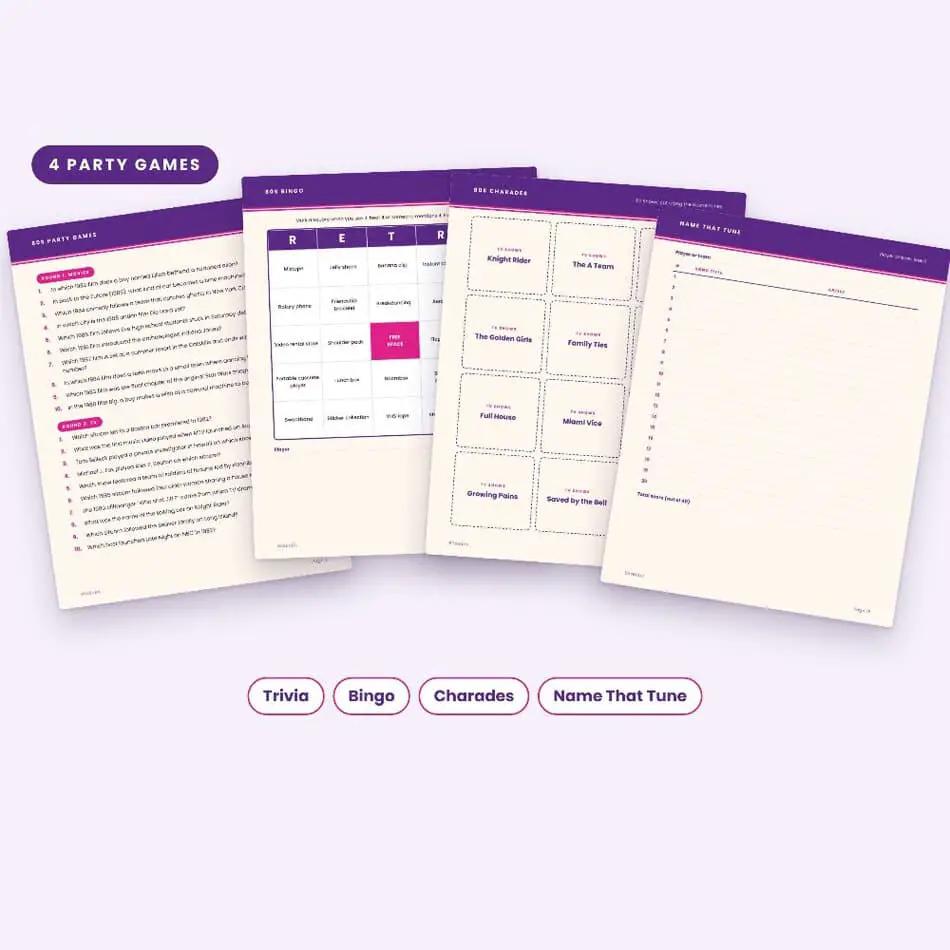
80s Party Games Printable Bundle
Trivia, bingo, charades, guess the decade and a throwback night, all in one printable bundle.
See it on EtsyWhy I think we feel it more
“I think we’re more nostalgic because we were the generation that grew up alongside the internet. We were the first test run. I remember dial up, that sound, and how you couldn’t talk on the house phone while someone was on the computer. Then as teenagers, we were the first to have actual cell phones. Our generation had a lot of firsts. We lived both lives: we were kids without the electronics, and then we grew up with them.”
Alicia, 80sbaby.org
We were the first test run
Pew Research Center counts millennials as anyone born from 1981 to 1996. That window matters, because almost every big piece of technology we use now showed up while we were growing up, not before and not after.
We were not born into it. We were not too old for it either. We were right there when it arrived, and we learned it the hard way, one crash, one busy signal and one lost file at a time.
Older generations met the internet as adults, at work, as a tool. Younger generations never met it at all, because it was simply always there, like running water. We met it as kids and teenagers, at home, as something brand new and a little magic. That kind of first meeting sticks with you.
The sound you can still hear in your head
Ask any millennial to make the dial up noise and watch what happens. They will try. Most of them will get surprisingly close.
That sound meant something. It meant you were about to go somewhere nobody in your family had ever been. It also meant you had to wait. Pages loaded one stripe at a time. A single song could take an hour. You planned what you wanted to do online before you connected, because the clock and the phone line were both running.
Waiting is a big part of why it feels so warm now. We earned every page. Nothing was instant, so everything felt like a little event.
Get off the internet, I need the phone
This is the part younger people never believe. In most houses, the internet and the phone used the same line. If you were online, nobody could call in and nobody could call out.
So the house had rules. You could go online after dinner, but not if your mom was waiting on a call. If the phone rang and nobody picked up, somebody was going to hear about it. If your sibling picked up the kitchen phone while you were connected, you got kicked off and had to dial in all over again.
It sounds like a hassle, and it was. But it also meant the whole family shared one door to the outside world, and everybody knew who was using it. The internet was something that happened in the middle of family life, not something everyone did alone in separate rooms.
The first teenagers with cell phones
Then, right around high school for a lot of us, the phone left the wall.
Pew found that 45 percent of American teens ages 12 to 17 had a cell phone in November 2004. By September 2009, it was 75 percent. In just five years, the cell phone went from something only some kids had to something almost every teen carried. The kids living through that jump were us.
Those first phones did not do much. Calls, texts typed by pressing the same key three times, maybe a game or two. You counted your minutes. You saved your texts because your inbox filled up. But it was the first time a teenager could talk to a friend without the whole house hearing, and that felt huge.
That is what I mean when I say our generation had a lot of firsts. The first email address. The first screen name. The first time a crush texted back. We were the beta testers for all of it, and we remember how it felt before anyone knew the rules.
We lived both lives
Here is the heart of it. Millennials remember life before the screens and life after them, and we remember the switch.
We played outside until the streetlights came on, and then we came home and fought over the computer. We had paper maps in the car and, a few years later, directions printed from a website. We wrote notes in class and folded them into tiny triangles, then a few years later we were sending the same gossip by text.
When you have lived both lives, you can compare them. You know exactly what got better and you also know exactly what got lost. That is what nostalgia really is: not just missing the past, but knowing the difference.
Other generations either never had that before and after moment, or they already had the technology by the time they were growing up. We are the bridge. Bridges remember both sides.
Why it hits harder now
So why does it feel stronger this year than it did ten years ago?
Part of it is age. Millennials are now in their 30s and 40s. A lot of us are raising kids of our own, and those kids have never heard a dial tone. Every time your child asks what a cassette is, or why you know your childhood phone number by heart, the gap between your two lives gets a little wider and a little more precious.
Part of it is the world around us. This year, news outlets from The Economist to NBC News have written about millennial culture coming back, from reunion tours to reboots of the shows we watched after school. Pinterest’s 2026 trends report leaned into comfort and escape, and nostalgia is one of the easiest kinds of comfort there is.
And part of it is simple: life is loud right now. Everything is fast, everything is online, and everyone is reachable all the time. Looking back to a time when the internet had to wait until your mom got off the phone feels calm. It reminds us that we used to have slow evenings, and that we can have them again.
How to bring a little of that back
You do not need a dial up modem to get the feeling back. You just need to recreate what those years gave us: everybody in one room, sharing the same thing, with nobody looking at their own screen.
A few easy ways to do it:
- Have a no phones game night. Put the phones in a basket by the door and play something everyone can join, from trivia to bingo.
- Do a then and now night. Everyone brings one photo from their childhood and tells the story behind it.
- Play the music. Make a playlist of the songs from your middle school years and let the kids judge it.
- Write it down. Ask your parents what they remember about the first time the family got online. Those stories disappear fast if nobody asks.
That shared room feeling is the part we miss the most, and it is the easiest part to get back.
Need a starting point? Grab the quiz from my 80s slang guide, pick a few 80s party games, or learn how to play Lotería with the whole family.
FAQ
What years are millennials?
Pew Research Center defines millennials as people born from 1981 to 1996.
Why are millennials so nostalgic?
Millennials grew up during the switch from an offline childhood to an online world. Remembering life both before and after the internet and cell phones gives that generation a clear sense of what changed, which makes nostalgia stronger.
When did most teenagers get cell phones?
According to Pew Research Center, 45 percent of American teens ages 12 to 17 had a cell phone in 2004, and 75 percent did by 2009.
And if your family’s version of a screen free night is Lotería at the holidays, this is the one I made for that.

Christmas Lotería Bundle
A printable Lotería in Spanish and English for the whole family.
See it on EtsySources
- Pew Research Center, “Teens and Mobile Phones,” chapter one (April 20, 2010): pewresearch.org
- Pew Research Center, generation definitions (millennials born 1981 to 1996): pewresearch.org
- The Economist, “Squeeze into those skinny jeans: millennial culture is back” (via The Nightly): thenightly.com.au
- NBC News, “It’s a good time to be a nostalgic millennial”: nbcnews.com
- Pinterest Newsroom, Pinterest Predicts 2026: newsroom.pinterest.com
This post was written with help from AI tools and checked by me. The memory quoted in it is my own.